What Is Dupcheswor Mahadev?
Most people outside Nuwakot have never heard of Dupcheswor Mahadev. Those who have visited once almost always return.
Dupcheswor Mahadev is a sacred Shiva temple located in Dupcheshwor Rural Municipality, Nuwakot District — roughly 65 kilometres north of Kathmandu. It sits on the banks of the Suryamati River, surrounded by terraced hillsides and old-growth forest, at an elevation of around 1,500 metres. The temple houses twin self-manifested Shiva Lingas inside a natural rock cave — a formation that is considered among the most spiritually significant in Bagmati Province.
It is known locally as the second Pashupati. That is not a casual comparison. It reflects the depth of belief that has built up around this place over several hundred years.
The Story Behind the Temple
Around 400 years ago, a local Tamang herder noticed his cow disappearing every day. When he followed her, he found her standing over a cylindrical stone projection, pouring her milk onto it without being told to. The villagers recognised this as a sign of divine presence and began worshipping the stone as Dudheshwor Mahadev — the milk god. Over time the name evolved to Dupcheswor.
A second legend connects the site to the Mahabharata. According to local tradition, Bhima of the Pandavas attempted to pull a Shiva Linga from the ground at this location. Instead of lifting it, he split it in two. Those two pieces — both self-manifested, neither placed by human hands — remain inside the cave temple today.
Whether you visit as a devotee or as a traveller, the origin story makes the experience different from walking into any other temple in Nepal.
Why People Come Here
Dupcheswor draws pilgrims for several reasons, and not all of them are the same reason.
Couples who have not been able to have children make the journey specifically to pray here. The belief that sincere prayers at Dupcheswor are answered for childless couples is centuries old and widely held. Beyond fertility, devotees come seeking blessings for health, clarity, and the kind of wish that cannot be granted anywhere else — what is called a vakal in Nepali tradition.
The major festivals bring enormous crowds. The Dhanya Purnima Mela held during the full moon of the Nepali month of Mangshir draws more than 50,000 visitors to a place that is otherwise quiet and unhurried. Maha Shivaratri fills the temple grounds with saffron, incense, and night-long prayer. Every Monday in Shrawan brings unmarried women seeking blessings for marriage.
Outside of festival days, Dupcheswor is one of the most peaceful places in Nuwakot. The walk across the suspension bridge over the Tadi River, the steep climb up to the temple, the view from the rocks above it — these are not tourist-brochure experiences. They are just what this place is like.
Getting to Dupcheswor Mahadev from Farm & Forest Resort
Farm & Forest Resort is one of the closest quality stays to Dupcheswor Mahadev. From the resort, the temple is approximately 1.5 hours by private vehicle — compared to 3 to 4 hours from central Kathmandu.
Most visitors from Kathmandu make Dupcheswor a single long day trip, spending the majority of it in the car. Staying at Farm & Forest the night before changes that entirely. You leave rested, arrive early before the crowds, and return in the afternoon to the resort's spring pool and forest rather than sitting in Kathmandu traffic.
Directions from Farm & Forest Resort to Dupcheswor Mahadev:
Farm & Forest Resort, Thanapati → Nuwakot highway → Bidur → Rautbeshi → Suspension bridge over Tadi River → 10 to 15 minute uphill walk to temple
A private vehicle is strongly recommended or we also provide pick and drop services. The final 5 to 7 kilometres before the suspension bridge are off-road and narrow.
What to Expect at the Temple
After crossing the suspension bridge on foot, a short but steep walk brings you to the temple entrance. The path climbs through forest and opens onto the rock face where the cave temple sits.
The interior is naturally formed — not built. The twin Shiva Lingas sit within the cave as they have for centuries, attended by a resident pujari. Offerings of cow milk and flowers are made throughout the day. On ordinary days the atmosphere is still and reverent. On festival days it is something else entirely.
The surrounding viewpoint above the temple offers a clear view across the Nuwakot valley and, on clear days, the distant snowline. This is one of the better Himalayan viewpoints accessible without a full trek, and most visitors do not know it exists until they arrive.
Good to Know:
Entry is free year-round
No parking charges at the suspension bridge
The off-road section before the bridge requires a jeep or motorbike during monsoon
Best visited on weekday mornings to avoid crowds
Carry water — there are limited facilities on the walk up
The full visit including the bridge walk, climb, and viewpoint takes 2 to 3 hours
Best Time to Visit
The temple is accessible year-round but the experience varies considerably by season.
October to February is the clearest and most comfortable time. The air is dry, the views are sharp, and the walk up to the temple is pleasant in cool weather. The Dhanya Purnima Mela falls in this window — usually in December — and is worth planning around if you want the full cultural experience.
March to May is warm and increasingly lush. Maha Shivaratri falls here and draws enormous crowds.
June to September is monsoon season. The landscape is intensely green, the river is full, and the off-road section before the bridge can be genuinely difficult. A 4WD vehicle is essential. The climb up to the temple is slippery. It is still doable but requires planning.
Staying Near Dupcheswor Mahadev
The standard approach to Dupcheswor from Kathmandu is a long day trip — leaving early, driving three to four hours, spending two hours at the temple, and driving back. It is exhausting and it means you arrive already tired from the road.
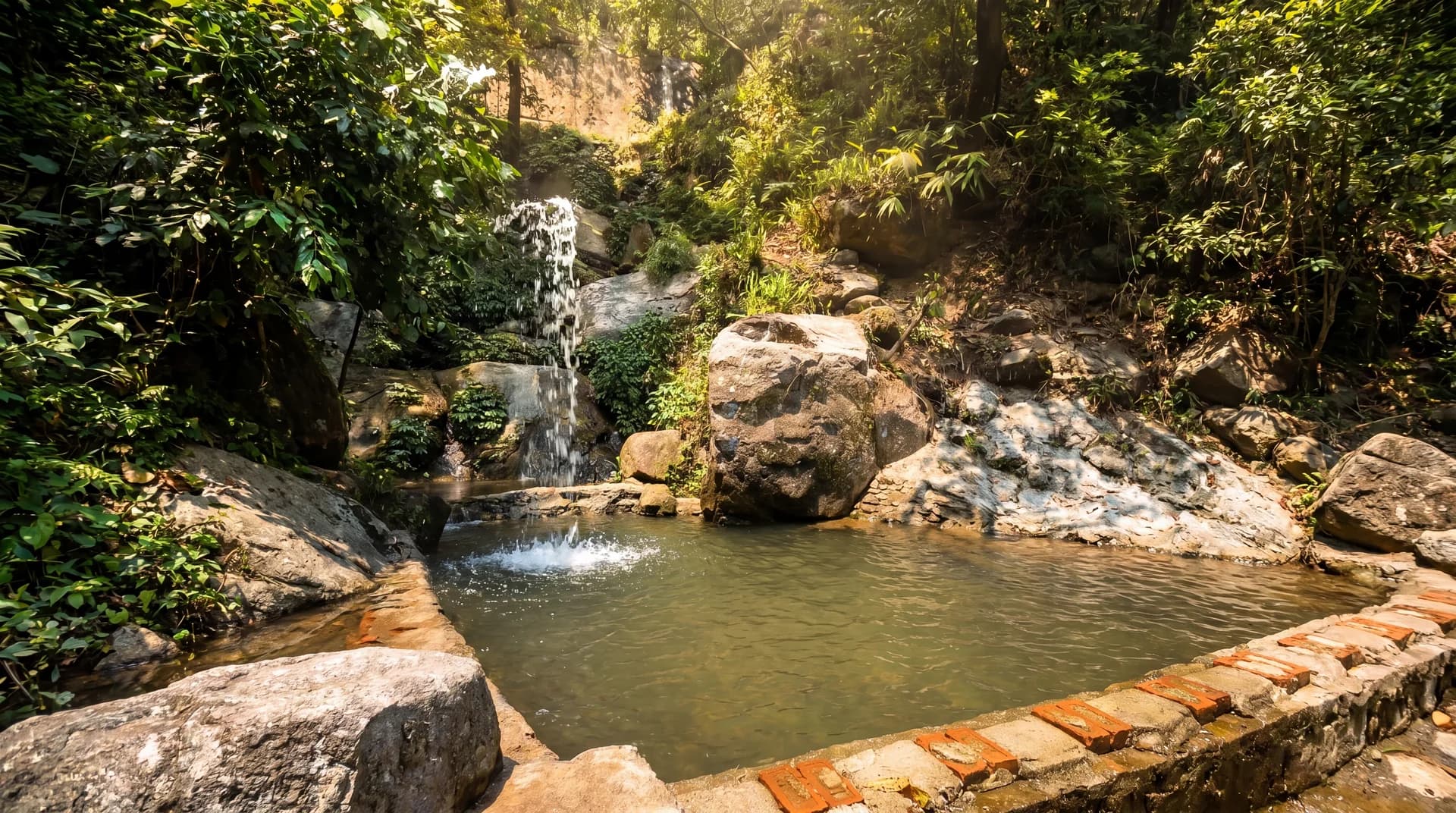
Farm & Forest Resort is approximately 1.5 hours from the temple, sitting on the Shivapuri hillside in Thanapati, Nuwakot. Staying here the night before means a morning departure, an arrival at Dupcheswor before most of the day-trip crowds from Kathmandu, and an afternoon return to a forest resort with a natural spring pool, open-air dining, and no city noise.
For pilgrims who want to approach Dupcheswor with the right energy — rested, unhurried, prepared — Farm & Forest is the natural base.
To book a stay before your Dupcheswor visit, contact us on WhatsApp.
.webp&w=3840&q=75)